


How Advisor Fees Change as Wealth Grows
Traditional AUM (assets under management) fees increase as portfolio values grow, while a flat fee remains consistent regardless of account size.
The comparison below illustrates how the difference can become substantial over time for higher-net-worth retirees and pre-retirees.
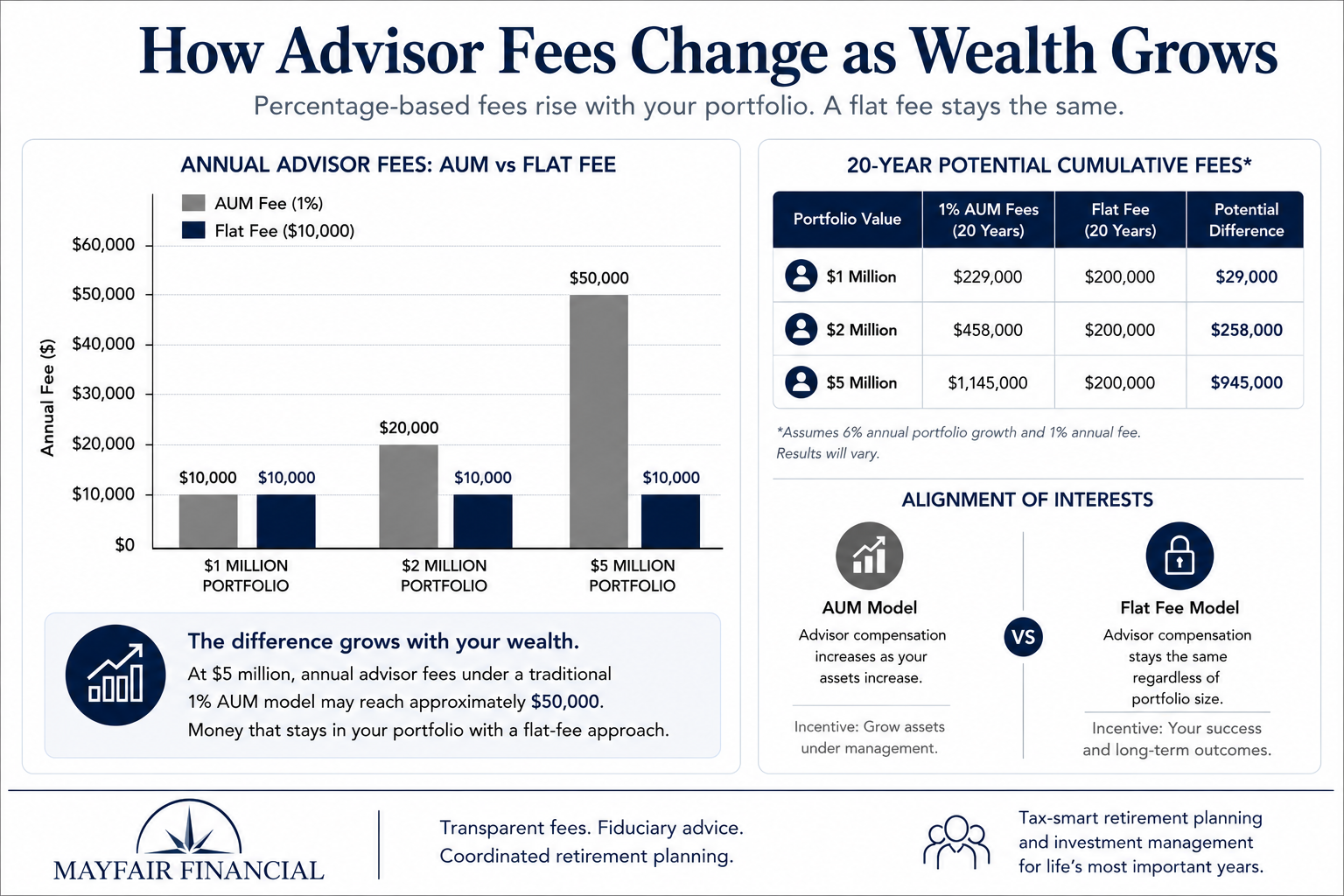
For retirees with larger portfolios, percentage-based advisor fees can significantly reduce long-term retirement wealth over time.
Why Some Retirees Prefer Flat Fee Financial Planning
Many retirees and pre-retirees are increasingly looking for:
- Transparent advisor compensation
- Coordinated retirement planning
- Tax-aware withdrawal strategies
- Fiduciary advice without product incentives
For higher-net-worth households especially, the long-term cost difference between percentage-based pricing and flat-fee planning can become substantial over decades of retirement.
Just as importantly, many people prefer knowing exactly what they are paying each year rather than watching advisory fees rise automatically as markets and portfolios grow.
About Our Flat Fee
At Mayfair Financial, based in St. Louis and serving clients nationwide, we use a transparent flat-fee model designed around retirement planning and long-term coordination.
For $2,500 per quarter, clients receive:
- Tax-smart retirement planning
- Ongoing investment management
- Coordinated financial guidance
- Proactive retirement income planning
All under one consistent fee structure.
Our approach includes:
- No commissions
- No loads
- No referral fees
- Fiduciary advice
- Independent planning without product ties
- A flat fee that remains the same regardless of portfolio growth (up to $10 million net worth)
Frequently Asked Questions
Is a flat fee financial advisor cheaper than a 1% advisor?
It depends on portfolio size. For smaller portfolios, costs may be similar. As portfolios grow, flat-fee structures can become significantly less expensive than percentage-based AUM fees.
What does a 1% advisory fee actually cost?
A 1% advisory fee means paying 1% of invested assets annually.
- $1 million portfolio = approximately $10,000/year
- $2.5 million portfolio = approximately $25,000/year
- $5 million portfolio = approximately $50,000/year
Are flat-fee financial advisors fiduciaries?
Some are, some are not. Investors should always ask whether an advisor acts as a fiduciary and is legally obligated to place client interests first.
Do flat-fee advisors manage investments?
Yes. Many flat-fee advisors provide both comprehensive financial planning and ongoing investment management.
Who benefits most from flat-fee financial planning?
Flat-fee planning is often most attractive to retirees, pre-retirees, and higher-net-worth households seeking coordinated planning, transparent pricing, and long-term retirement guidance.
The content is developed from sources believed to provide accurate information. The information in this material is for educational purposes only and is not intended as tax, investment, or legal advice. It may not be used to avoid any federal tax penalties. Please consult legal, investment, or tax professionals for specific information regarding your situation. Mayfair Financial and FMG Suite developed and produced this material to provide information on a topic of interest. FMG is not affiliated with the named state-registered investment advisory firm. The opinions expressed and material provided are for general information and should not be considered a solicitation for the purchase or sale of any security.
Data current for the 2026 tax year; Updated May 2026