


Mayfair Retirement & Investment Perspectives
Joe Petry, Ph.D., CFP®, EA, CRPC® | Updated August 2026
The widow’s penalty is the jump in taxes a surviving spouse faces after the first spouse dies. Household income falls — one Social Security check stops — but the survivor must file as a single taxpayer, on roughly half the standard deduction and far narrower brackets. Less income, higher tax.
Plans are usually built for two people
Almost every retirement plan assumes two Social Security checks, a joint return’s wider brackets and deduction, and two people at the kitchen table deciding what to do next. One of you will manage it alone.
That isn’t a morbid thought. It’s arithmetic — and it’s the most predictable event in your retirement that most plans never model. Nearly everything that makes it harder can be softened, but only while you are both still here to do it.
Less money, a bigger tax bill
Social Security keeps paying the larger of your two benefits and stops the smaller one, so the household loses a check. A pension may drop by half or end entirely. Meanwhile the IRA is the same size, the required distributions are roughly the same, and the dividends still arrive on schedule.
Then the filing status changes. For the year of death you can generally still file jointly. After that, unless you have a dependent child, you file as a single taxpayer — on about half the standard deduction, with brackets roughly half as wide.
Same portfolio. Less income. Much less shelter.
What the widow’s penalty looks like in dollars
A couple, both 73, receive $76,000 in Social Security — $48,000 his, $28,000 hers. Their IRAs generate $70,000 in required distributions and their taxable account throws off $14,000. He dies; her Social Security steps up to his and hers stops. Household income falls $28,000, and nothing else about their finances changes.
Table comparing a retired couple’s income and taxes with the surviving spouse’s, showing income falling while taxable income and federal tax rise.
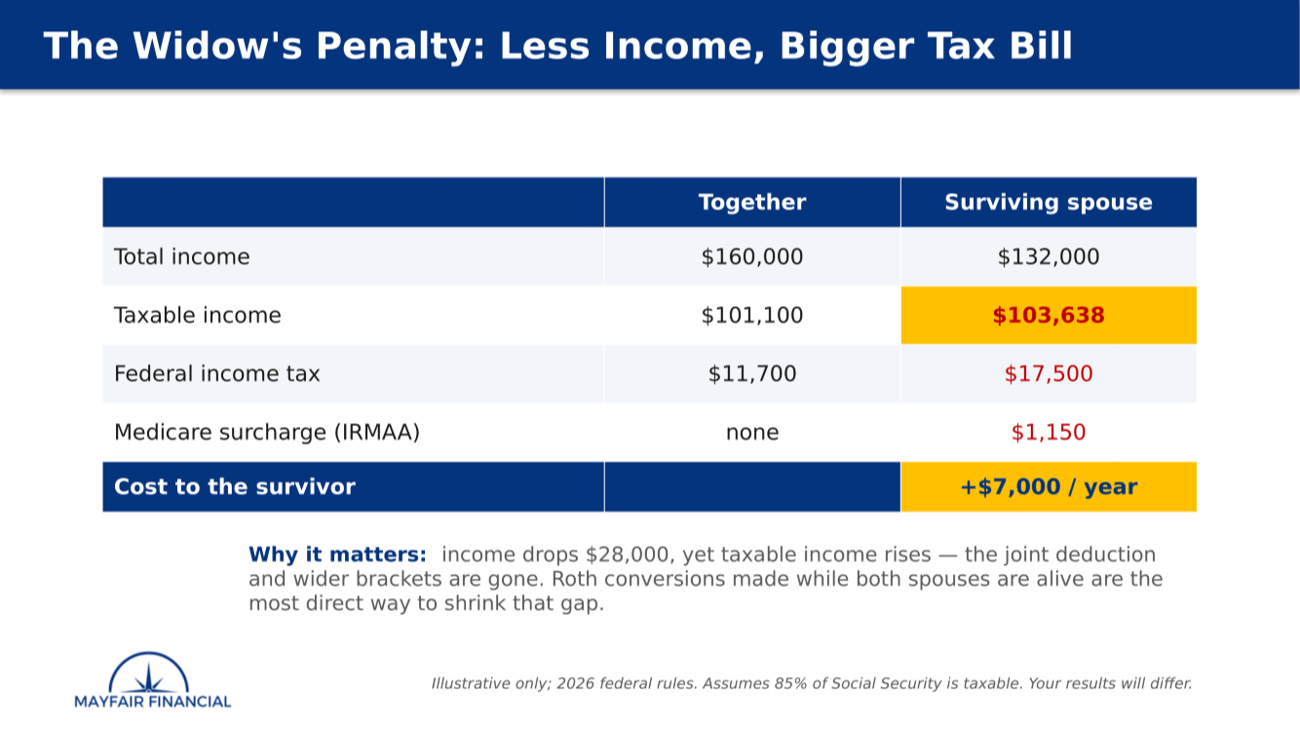
Look at the second line. Her taxable income went up — on $28,000 less actual income, because the deductions shrank faster than the income did. That is roughly $7,000 a year, arriving in the same season as everything else.
What you can do about it — now, together
Almost every fix depends on being able to file jointly, which means doing it while both spouses are alive.
• Convert to Roth while the married brackets are open. Money converted today is taxed in the wide joint brackets; money left in the IRA may come out in the narrow single ones, on top of distributions the survivor cannot avoid.
• Read Social Security timing through the survivor’s eyes. The higher benefit is the one the survivor lives on. Delaying it is less a bet on longevity than a purchase of income for whichever of you is left.
• Check the pension election and every beneficiary designation. A single-life election usually cannot be undone, and beneficiary forms override your will. They go stale quietly — after a rollover, a new account, a change in the family.
• Know how each account will actually transfer. Some pass automatically to the survivor. Some require probate. The survivor should not be learning the difference during the first week.
• Keep the safe bucket funded. Several years of spending in short-term, high-quality government paper means the worst year of someone’s life is not also the year they must sell stocks to pay the bills.
• Check whether a real insurance gap exists. Sometimes coverage is the right bridge; for couples who have already built enough, often it isn’t. We don’t sell insurance and earn no commissions, so it is simply a question we answer one way or the other.
The half that isn’t arithmetic
In most couples, one person handles the money and the other trusts them — a reasonable division of labor, right up until the moment it isn’t. The fix is participation: both spouses at every meeting, both understanding not just what we’re doing but why. If only one of you can explain the plan, the plan has a single point of failure.
Alongside that, one page listing where the accounts are, who to call, and what happens first. And the survivor should already know their advisor — not as a name on a statement, but as someone they have talked to and asked a dumb question.
Frequently asked questions
When does a surviving spouse start filing as single?
Generally, you can still file jointly for the year your spouse died. After that, unless you have a dependent child — which allows qualifying surviving spouse status for up to two more years — you file as single. For most retired couples that means single rates begin the very next tax year.
Do Roth conversions really help with the widow’s penalty?
They are the most direct fix available. A conversion moves money out of the pre-tax account at today’s joint rates, lowering both the future required distributions and the balance that would later be taxed at single rates. Each year’s conversion should be sized to that year’s actual income, not chosen once and repeated.
Does the widow’s penalty affect Medicare premiums?
Yes. The income thresholds that trigger Medicare’s income-related surcharge are far lower for a single filer, so a survivor can cross into a surcharge bracket without their income rising at all. Because the surcharge looks back two years, it usually arrives a year or two after the loss.
The point
Nobody wants to spend an afternoon on this, and it gets postponed year after year for understandable reasons. But it is the one part of your plan that protects the person least equipped to rebuild it, and the window for acting closes without warning.
We’re happy to walk through how this applies to you — just reach out.
This article is educational and is not individualized investment, tax, or legal advice. Figures reflect 2026 federal rules and are illustrative only; tax law changes and the right approach depends on your specific circumstances.
Figures are 2026. The $6,000 senior deduction used in the example expires after 2028.